
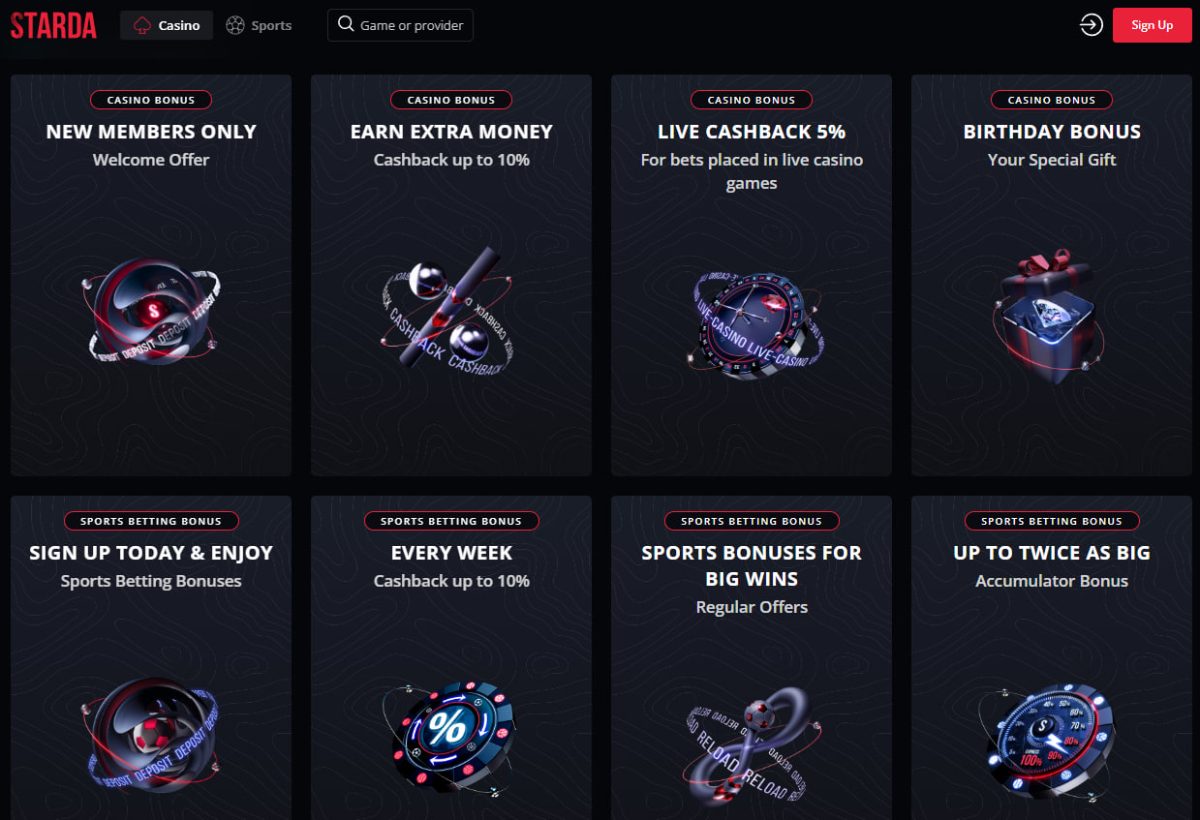
Promotional structure at Starda Casino is unusually compact for the segment, and that turns out to be a compliment. No promo codes exist. Four matched deposits open the account — 100% to $600, then 75%, 75% and 50% — with as many as 500 free spins riding on the first. Friday brings a rebate reaching 10% of losses. Birthdays bring cash if you have deposited enough. A four-rung loyalty ladder sits under everything, and unlike most such schemes it pays out in the only currency that matters: how much money you may remove per day.
Two findings shape this page, and neither appears anywhere else we looked. First, that staircase is priced backwards — twenty dollars buys spins at two and a half apiece, three hundred buys them at one and two-thirds. The headline rewards the big deposit in absolute terms while quietly penalising it per dollar. Second, the cashback ladder is the genuine prize here, and it works the opposite way to how these normally work: climbing does not raise your rebate past 10%, it lowers what you must stake to keep it — from twenty times down to three.
Coverage below breaks down every documented campaign against its own terms, works the rollover at realistic sizes, prices the loyalty rungs honestly, and flags the contradictions that would cost money if taken on trust. Nothing is invented; where sources disagree, both readings appear.
Deposit twenty dollars and the offer applies. No code, no opt-in gymnastics — one Canadian tester reported the credit arriving immediately on sign-up and being playable straight away. What varies is the spin count, which tracks your deposit on a published five-rung scale.
| Deposit | Spins awarded | Spins per dollar funded | What the ladder is doing |
|---|---|---|---|
| 🪙 $20 | 50 | 2.50 | Best value on the scale, at the smallest possible risk |
| 💵 $30 | 75 | 2.50 | Identical rate — the sweet spot extends this far |
| 💰 $60 | 100 | 1.67 | Rate collapses by a third exactly here |
| 🏦 $150 | 250 | 1.67 | No recovery |
| 🎰 $300 | 500 | 1.67 | The headline figure, at the worst rate on offer |
That third column is ours. Nobody publishes it, and it inverts the marketing entirely. Chasing five hundred spins costs you thirty-three percent more per spin than taking fifty would. The advertised number is real, the value is not, and a reader who understands the scale will deposit thirty dollars rather than three hundred.
Confusing these costs money, so take them separately.
Read that second line again. Spin winnings carry no ceiling. Credit winnings stop at ten times. On this platform the spins are structurally the better half of the welcome offer, they roll over at three-quarters the rate, and their upside is unbounded — which is the reverse of how most operators build these, and a genuine point in the brand's favour that its own marketing buries under a big number.
Fund the entry point:
Now chase the headline:
Push it to the maximum match and the picture worsens: $600 funded produces $600 credit, a $24,000 turnover obligation, and a $6,000 ceiling — no additional spins, since the ladder tops out at three hundred dollars. Everything above that threshold buys match credit alone, at the least favourable rollover on the platform.
Fund thirty dollars. That figure is not arbitrary — it is the last rung before the spin rate collapses, it produces seventy-five spins with unbounded upside and the lighter of two rollovers, and it keeps your credit obligation at $1,200 rather than five figures. Anyone funding three hundred to collect the full allocation is paying a premium for a number on a banner. Should you want the larger match on its own merits, take it knowing the spins stopped scaling at $300 and the rollover did not.

Deposits two through four carry declining matches. Caps are where the record fractures.
| Deposit | Match | Ceiling | Code |
|---|---|---|---|
| 🥇 First | 100% | $600 — agreed everywhere | None |
| 🥈 Second | 75% | $300 per two sources · unstated by a third | None |
| 🥉 Third | 75% | $300 per two sources · unstated by a third | None |
| 4️⃣ Fourth | 50% | $300 per two sources · unstated by a third | None |
One Canadian listing prints the percentages and leaves the ceilings blank. An affiliate covering legality gives $300 across all three. A bonus database independently records offers of 75% to $300, 50% to $300, plus separate entries at 100% to $300 and 75% to $150 — different currency lines, most likely, but corroborating the three-hundred figure. We read $300 as the likelier ceiling on two independent citations. Confirm before funding, because a 75% match capped at three hundred and an uncapped one are not the same product.
Worth noting separately: one specification panel headlines this brand's welcome offer as 50% up to €300, which matches none of the above. That figure appears to describe a European campaign rather than the Canadian one, and it explains a chunk of the confusion around this operator's bonuses.
Here is the campaign the marketing underplays.
| Tier | Rebate | Rollover | Cost per dollar rebated |
|---|---|---|---|
| 🥉 Mid | 5% | 20× | $20 staked per dollar returned |
| 🥈 High | 10% | 10× | $10 — half the entry cost, double the rate |
| 🥇 Top | 10% | 5× | $5 |
| 👑 Pro | 10% | 3× | $3 — a sixth of what entry tier demands |
| 👑 Pro, live tables | 5% | None | Converts straight to withdrawable money |
Look at what happens across those rows. The rebate itself stops improving after the second rung — ten percent is the ceiling from High onward. What keeps improving is the price: the same money at half the turnover, then a quarter, then under a sixth. Most loyalty schemes dangle a bigger number and quietly hold the rollover flat. This one does the opposite, which is the honest construction, and it means the ladder is worth climbing for reasons that survive arithmetic.
Mechanics: losses are rebated Friday between 9 and 10 in the morning UTC, and the award lives 72 hours. No code. The live-table rebate at the summit carries no rollover whatsoever, making it the only campaign on the platform that converts directly into withdrawable funds.
A Canadian reviewer objected to tiering a birthday gift, singling out the entry rung getting nothing. We disagree, mildly. Priced against thirty days of deposits, this is a retention instrument wearing a party hat — and being explicit about that is better than the alternative, where the same money arrives dressed as generosity. Sixty dollars against $750 funded is a rebate of eight percent, and readers can decide for themselves whether that reads as a gift.
Four rungs — Mid, High, Top, Pro. Progression runs on points earned at one per $20 wagered. Thresholds go unpublished, which is the scheme's least attractive feature: you cannot calculate the distance to a tier whose entry cost nobody states.
What you can calculate is what waits there, and it is not merchandise:
Compare that against the loyalty ladders we usually take apart — twenty-five decorative levels, a watch at the top, points accruing on reels alone and nothing else. This one has four rungs, pays in withdrawal capacity and rebate pricing, and lets any wagered dollar count. Whether you reach the summit is another matter, since $22,500 daily is plainly built for somebody whose staking volume we are not going to guess at. But the shape of it is sound.
Exclusions here are extensive, and the operator handles them better than most.
Multiple players report that large portions of the library go dark while bonus money sits in the account. One noted that nearly all the famous releases lock, and another wrote that "many blocked games with bonus money" was his single complaint about a casino he otherwise praised. That is a real limitation and worth knowing before you accept credit.
What redeems it: barred titles simply will not load, rather than accepting a stake and quietly contributing nothing. One player called that behaviour "very positive", and he is right — the failure mode most operators choose is silent non-contribution, discovered at the end of a rollover. Beyond that, the lobby carries a filter for whether a game is eligible for wagering, and the operator has publicly pointed players at a dedicated control for finding qualifying titles. Between the filter and the hard block, this is the least deceptive bonus-exclusion system we have documented in this segment.
One structural warning from the complaint files. A player reported being told his balance would release only after he deposited additional money and wagered it three times, under a clause covering consecutive bonus use — a clause he insists never applied, having taken a single offer. Whatever the merits, read the bonus terms before accepting credit, not after a payout is refused.
Three things stand up. Spin winnings carrying no ceiling at 30× rollover is a better deal than the credit it accompanies, and almost nobody says so. Cashback that gets cheaper rather than larger as you climb is the honest version of a loyalty scheme. And a blocking scheme that locks titles outright while filtering the lobby for eligibility beats the industry's preferred approach of letting you discover the problem at the end.
Three do not. That spin ladder is priced to punish the deposit it advertises, and the per-dollar collapse at sixty dollars is deliberate enough to be worth calling out. Rollover at 40× on credit runs above the 30–35× the segment generally asks. And reload ceilings sit unstated on the source most Canadians will read, with two other sources putting them at $300 — a gap that changes what those later top-ups are worth.
Compressed to four lines: put in thirty dollars, take the spins seriously and the credit lightly, climb far enough for the cashback price to drop, and read the exclusion filter before you spin rather than after.
A 100% match to $600 arriving alongside up to 500 spins, opened by a twenty-dollar deposit, requiring no code. Spins scale with what you fund: fifty at $20, seventy-five at $30, a hundred at $60, 250 at $150, five hundred at $300. Credit rolls over at 40× and caps winnings at ten times; spins roll over at 30× and cap nothing.
No. Standard campaigns apply automatically — the welcome match on deposit, Friday rebate without action, birthday money by tier. A Canadian tester confirmed receiving the offer immediately on registering with nothing typed. Exclusive strings do circulate via outside partners for no-deposit spins, but the core structure needs none.
Forty times on bonus credit, thirty on free-spin winnings. Segment norm sits nearer 30–35×, so the credit side runs demanding while the spin side sits at the lighter end. Rollover applies to the bonus rather than deposit-plus-bonus, which is the friendlier of two possible constructions.
Those opening spins, and then the cashback once you have climbed a rung. Anything won on spins has no cash-out ceiling and rolls at three-quarters the credit rate — a combination this brand's own marketing never mentions. Cashback at the fourth tier costs three dollars staked per dollar returned, against twenty at entry, and the dealer-side rebate there is free of any playthrough.
Five hundred, for a $300 deposit. Whether you should is a different question: the ladder pays 2.5 spins per dollar at $20 and $30, then drops to 1.67 from $60 upward. Chasing the headline costs a third more for each spin than the floor does. Fund exactly thirty if spins are the point.
Just one — Mechanical Clover, built by BGaming. One title, no alternative offered. Given that winnings from spins face no cap here, that constraint matters less than it would elsewhere — but if the game does not suit you, the credit half of the offer is the weaker half.
A substantial share of the library, by several accounts — one player wrote that almost every recognisable release freezes while credit is active. Two things soften it. Barred games decline to launch instead of swallowing stakes that never count, which is the honest failure mode. And the lobby filters by wagering eligibility, so the qualifying list is two clicks away rather than buried in terms.
Money comes back each Friday, landing between 9 and 10 UTC, and stays live for three days afterwards. Entry tier returns 5% at twenty times rollover; every rung above returns 10%, at ten times, then five, then three. Reaching the summit adds a separate dealer rebate carrying nothing to play through.
Levels run Mid, then High, Top and Pro, with a point per $20 wagered and thresholds the operator does not publish. Benefits concentrate where they count: daily cash-out capacity rising from $6,000 to $15,000 to $22,500, cashback getting progressively cheaper, coin maximums lifting, processing shortening, plus activity-based offers from level three.
Not as a standard campaign. Exclusive no-deposit spin offers have circulated through third-party channels — fifty spins under one code, a hundred on registration under another — but those are partner arrangements rather than a permanent fixture. Several players list the scarcity of no-deposit offers among their complaints, and one asked specifically for more of them. The birthday award is the closest thing to free money here, and it is gated behind a month of steady funding.
No. That province has operated a closed registered market since spring 2022, open only to operators that register provincially and contract with its market operator, and a Curaçao permit sits outside that structure entirely. Every campaign described above — the opening match, its spin staircase, Friday rebate, birthday money, loyalty progression — is out of reach for residents there.